
UNIQUE PIANOS
Piedmont Piano Company stocks some of the most rare and unique instruments known. Our curated collection of ‘unique’ pianos is comprised of only the most special and valuable instruments: many previously owned by notable individuals or families, others with exquisite decorative art cases. This sampling has instruments representing generations of craftsmanship. Each piano has a story to tell.

A dozen years ago a large organization made a special order of Yamaha grand pianos specifying they have a natural oak finish, a finish never before used on Yamaha grands. Yamaha offered a very small number of these pianos for sale to the general public and this piano was purchased new here in the Bay Area in 2010. We are now offering it for sale to settle the estate of its original owner. The piano is virtually unused and is in new condition inside and out. The Yamaha C2 is a fine musical instrument and this example will satisfy the most particular pianist. Size 5ft 8in, serial number 6280708.
SOLD
This piano is sold. However, we can source one like it. Contact the store with all your piano needs!
(510) 547-8188

1939 Steinway M Art Deco
We are pleased to offer this rare and beautiful Steinway in a special art case. The elegant art deco design was created for Steinway in the late 1930s by renowned industrial designer Walter Dorwin Teague. Only a small number of these unusual pianos were built and they are extremely hard to find today. We acquired this piano locally after it had spent years in storage. We have had the cabinet refinished to the highest standard in satin ebony lacquer but the rest of the piano is factory original and in outstanding original condition. In addition to the striking cabinet design, this piano was set apart from standard Steinways with a silver painted frame with grey understring felt, and an engraved Steinway logo on a nameplate over the keys. To complete the special look of the Teague designed ebony pianos, the hardware was plated in chrome instead of the usual nickel, giving the piano a 1930s “modern” look. These features survive in top condition, as do the original ivory keys. The soundboard is in flawless condition and the piano plays beautifully with a warm tone, and is still accompanied by its original Steinway chair in matching ebony. Size 5ft. 7in. Serial number T374.
SOLD
This piano is sold. However, we can source one like it. Contact the store with all your piano needs!
(510) 547-8188
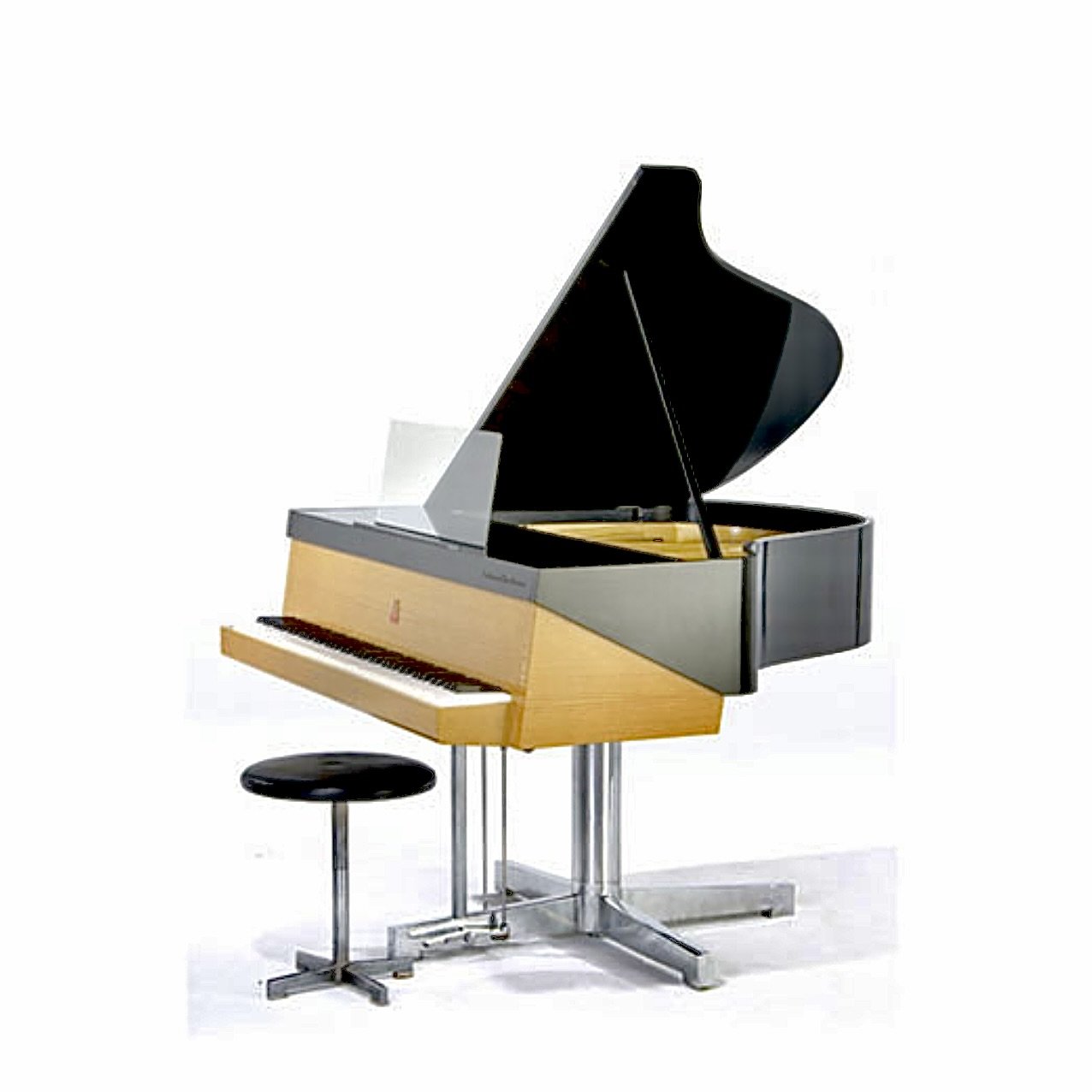
This stunning mid-century design was created in Copenhagen in the 1960s. Andreas Christensen started producing pianos in 1912, he embraced modern Danish design and worked with the best contemporary architects, such as Torben Christensen, Alfred Skjøt-Pedersen and architect and designer Poul Henningsen who designed the acclaimed PH grand piano.
This exceedingly rare 1960s design features a case of ebony and blonde oak, ivory keys, and a striking pedestal base in gleaming stainless steel. Overall condition is excellent. Size 4ft 8in. Serial number #12261

The remarkable PH Piano was designed in 1931 by noted Danish architect and inventor Poul Henningsen. Less than one hundred PH Pianos were made in Copenhagen in the 1930s and those that have survived to the present day are highly sought after collectors items.
Offered for sale exclusively by Piedmont Piano Company is the NEW PH Piano, an exact reproduction of the original, individually made by hand in Leipzig, Germany by Julius Blüthner Pianofortefabrik GmbH, one of the world’s oldest and most respected piano makers. In addition to its stunning apperarance, the new PH Piano is one of the world's finest musical instruments.
Each PH Piano is custom made and is available in a variety of finishes and upholstery materials.
The PH piano is available in the United States ONLY at Piedmont Piano Company

We are pleased to offer this very rare Gaveau baby grand in a graceful two toned mahogany and maple cabinet in the most sophisticated 30's French high style. Gaveau of Paris made some of the finest art deco art-case pianos in the 1920s and 30s. This exceptional example is in extremely fine original condition, having never been rebuilt or refinished, and appears nearly new in many respects. The original strings are in excellent condition as is the action with all original components. The original soundboard is flawless with no cracks, and the piano plays beautifully with a very responsive action and a typical French tone which is delicate yet powerful, belying the piano’s compact size. The cabinet with its exotic woods still presents its original 1931 finish which has just been professionally French polished and has a beauty and depth not seen in refinished examples. The original ivory keys survive in perfect condition. This is a rare opportunity to acquire a remarkable instrument of extreme beauty and historical significance. Length 5ft. Serial number 89901.
History: This remarkable piano was purchased new in Paris in 1931 by the Litton family and delivered to their apartment on rue Cognacq-Jay near the pont de l’Alma, where it joined a large collection of the most fashionable Art Deco furniture. The Littons left France for New York in 1939 and settled in a large apartment on the Upper West Side, bringing the furniture and piano along. The Littons were part of a circle of European artists and intellectuals and hosted parties where the elegant Gaveau was played by the likes of Nadia Reisenberg and Arthur Rubenstein. Their son George Litton who was in his teens at the time remembers these parties fondly. After his father’s passing in the 1950s, George's mother moved to a smaller apartment and sold most of the Art Deco pieces but loved the piano and kept it with her.
The next fascinating chapter of the piano’s story began in the mid 1960s when George Litton started his family and the piano was played by his son Andrew, a very promising young musician. Andrew’s hard work at the piano produced excellent rewards as he is today one of the most highly regarded conductors and pianists of his generation, currently holding the positions of Music Director of the New York City Ballet, Principal Guest Conductor of the Singapore Symphony Orchestra, Conductor Laureate of Britain’s Bournemouth Symphony and Music Director Laureate of Norway’s Bergen Philharmonic. He guest conducts the world’s leading orchestras and opera companies and has a discography of over 120 recordings with awards including America’s Grammy, France’s Diapason d’Or, and many British and other honors. Interested parties can read more about Andrew Litton here.
Design: The design of this piano is attributed to Dominique, one of the premier Art Deco design houses in Paris, and a piano of similar design is pictured in photos from the French luxury liner Normandie.
Dominque was founded by Andre Domin (1883 - 1962) and Marcel Genevriere (1885 - 1976). Their furniture design was characterized by simplicity and dignity. One of Dominique's first commissions was to provide furniture for the home of silver designer Jean Puiforcat in Biarritz. This was followed by a commission to do the establishment of the perfumer Houbigant in Neuilly. Beginning in 1926 Dominique exhibited with Chareau, Legrain, Puiforcat and Raymond Templier as the "Groupe des Cinq". They also exhibited at the Exposition Colonial in Paris in 1931 and created a "Salon de Musique" for the 1937 Exposition Internationale des Arts et Techniques also in Paris.

This is a very unusual baby grand and we have never seen another one like it. It was built in Copenhagen in 1951 by the small maufacturer Andreas Christensen, the same maker who commissioned the remarkable PH piano (offered elsewhere on our site) in the early 1930s. Clearly they were keenly interested in design and this piano is a beautiful interpretation of the Danish Modern style executed in mahogany veneer and white enamel. The piano is in very good original condition, including flawless ivory keys. Despite its small size the tone is beautiful and well balanced, with a responsive action. A unique opportunity. Size 4ft 6in. Serial number 9076.

For more information about this piano please contact us at 510-547-8188 or email music@piedmontpiano.com
Size 5ft 2in. Serial number #169090.
SOLD
This piano is sold. However, we can source one like it. Contact the store with all your piano needs!
(510) 547-8188
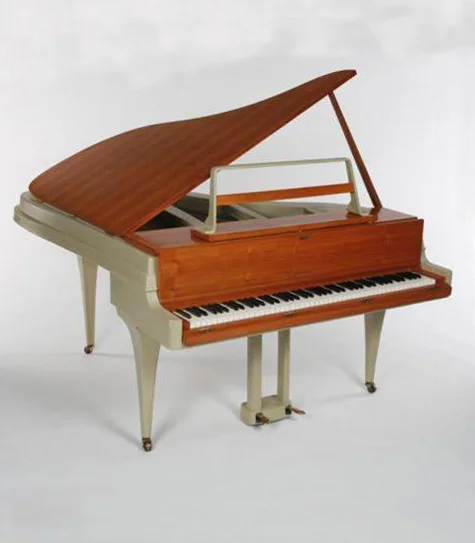

For more information about this piano please contact us at 510-547-8188 or email music@piedmontpiano.com
Size 5ft 2in. Serial number #145059.

This rare Steinway is one of a limited number of "contemporary" models built in the 1950s and 60s. It was designed in 1953 by Walted Dorwin Teague, who also designed some beautiful art deco cases for Steinway in the 1930s. The creation of this modern design was to honor the 100th anniversary of the founding of Steinway & Sons, and it is sometimes called the Centennial model. We acquired this piano from its original family, and it has spent its entire life here in the friendly California climate. Internally it is in fine condition. The mahogany exterior was redone at some point in a light brown tone - if a new owner so desires we can have the piano refinished in a darker mahogany or ebony. Size 5ft 7in. Serial number #352916.
SOLD
This piano is sold. However, we have another one like it available in Satin Ebony. Contact the store with all your piano needs!
(510) 547-8188

Here is an extremely rare instrument - a spinet piano with built in electronic organ. Janssen was a maker of high quality small pianos in the 1940s through 1960s, and through a joint venture they installed Lowrey organs in a limited number of their pianos. Although we are aware of few Janssen "Lowrey Organo" pianos existing we have never seen even a photo of another is this wild mid-century case design. The piano here is in fine condition as is the blonde cabinet. The Organo is functional and has an striking "vintage" organ sound although the pitch on certain notes is sounding rather strange. We assume a good vintage electronics technician will be able to make everything right. Height 39in. Serial number #110077.

This extremely rare piano was designed by Story & Clark, a manufacturer on the cutting edge of both design and technology in the 1930s and 40s. (see also our Storytone electric piano designed around the same time) It features stunning art deco lines and an internal wood "grille" covering the strings and plate. This piano survives in good unrestored condition with its original blond finish and beautiful ivory keys. Story & Clark was a quality piano builder and despite its diminuitive size this piano is very well designed and built and has a fine sound. Length 5ft. Serial number 203007.
SOLD
This piano is sold. However, we can source one like it. Contact the store with all your piano needs!
(510) 547-8188
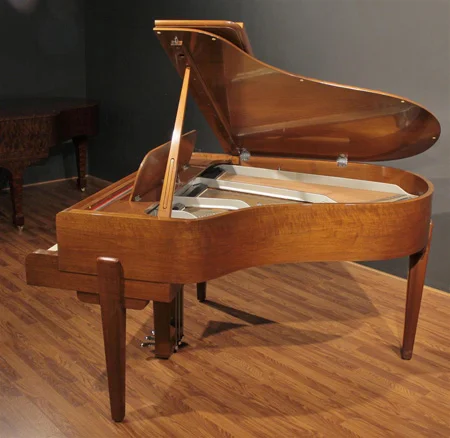
1941 Steinway M Art Deco
We are pleased to offer this rare and beautiful Steinway in a special art case. The elegant art deco design was created for Steinway in the late 1930s by renowned industrial designer Walter Dorwin Teague. Only a small number of these unusual pianos were built and they are extremely hard to find today. The vast majority were built with mahogany or ebony cases, but this example is in a beautiful figured American walnut. The cabinet was refinished to a high standard some years ago, but the rest of the piano is factory original and in outstanding original condition. In addition to the striking cabinet design, this piano was set apart from standard Steinways with a silver painted frame with grey understring felt, and an engraved Steinway logo on a nickel plated nameplate over the keys. These features survive in top condition, as do the original ivory keys.The soundboard is in flawless condition and the piano plays beautifully with a warm tone, and is still accompanied by its original Steinway chair in matching walnut. Size 5ft. 7in. Serial number 310528.
SOLD
This piano is sold. However, we have another Steinway M of this rare design in mahogany finish. Contact the store with all your piano needs!
(510) 547-8188

This is an extremely rare and historically important instrument. The Storytone piano was built in 1939 in a joint venture between Story & Clark and RCA - the piano has normal strings and action but no soundboard - the sound is amplified by pickups and a speaker system making it the world's first practical electric piano. The sound is very beautiful considering its design during the infancy of amplified instruments. As you can see the design is striking - art deco at its most radical. In excellent condition. Height 36" Serial number #157432.
We have three of these pianos available. Call us for more information!
(510) 547-8188
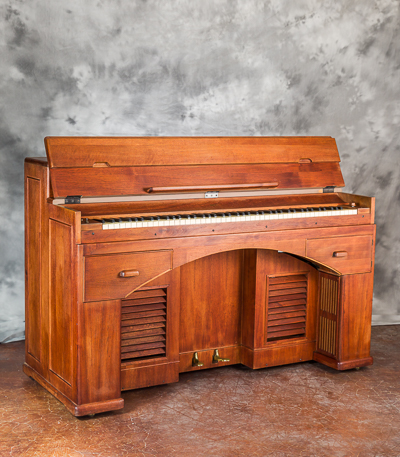
Here is another very unusual early electric piano. Rarer and less well known than the acoustic-electric Storytone, The Ansley Dynatone similarly combined an electric piano, radio, and phonograph into one “home entertainment” package. We acquired this instrument from the original owner’s family - it had been purchased new at the 1939 Golden Gate International Exposition in San Francisco and lovingly preserved in the same home here in Oakland ever since. We are not aware of any other example outside of several in museum collections. Here is a brief history of the Ansley Dynatone, from the Museum of Making Music:
The Ansley Radio Corporation, founded by Arthur Ansley, had some success in the 1930s with a product line called the Dynaphone, a combination phonograph and radio. Late in the decade, Ansley utilized its expertise in electronics to create another hybrid product: the DynaTone, a combination phonograph, radio, and piano, which was released in 1939. The DynaTone was marketed both as a good value ($595 in 1939, or around $10,000 in 2017 dollars) and as a piece of advanced, cutting-edge technology—not only electrified, but also capable of receiving then-new frequency modulated radio signals.
Though outwardly very similar to an upright piano, the DynaTone has no soundboard. Instead, a set of pickups mounted inside the piano convey the sound of the strings to an amplifier and then to a speaker—all inside the instrument. With the amplifier switched on, the DynaTone can be as loud as a grand piano. With it switched off, the sound is considerably softer; marketing materials referred to this as a “harpsichord” sound, adding yet another hybrid capability to the instrument.
The phonograph and radio portions of the DynaTone are cleverly tucked away in hidden cabinetry. A handle below the left side of the keyboard pulls out a drawer housing a phonograph platter and tonearm, and a handle below the right side opens a door concealing a radio dial and controls. These could be used at the same time as the amplified piano, such that the player could perform along with the radio or a record.
Production of the DynaTone ended in the 1940s. While a precise cause is impossible to pin down, the DynaTone’s success was likely hampered by its novelty and the onset of World War II, during which musical instrument manufacturing was effectively frozen nationwide. Nonetheless, the DynaTone is an amazing example of ingenuity and adventurousness. Height 36".
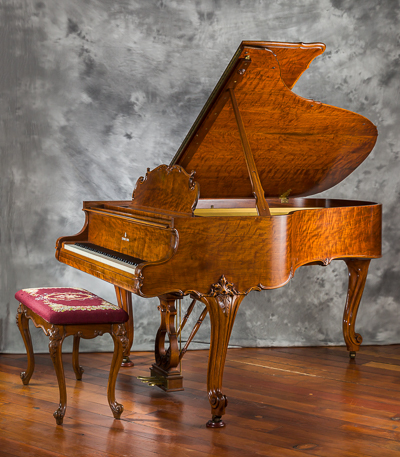
This stunning hand carved instrument came to us from long term ownership in an elegant home in Reno, Nevada. The case is in a highly figured shimmering mahogany veneer and is in superb condition. The piano was restrung at some time in the past but is otherwise original and in excellent condition, including the original ivory keys. The tone and touch are exceptional. This Steinway is still mated with its rare original matching bench which has an attractive needlepoint cover. A new Steinway Louis XV is only available in the smaller model M, retailing for over $140,000 - our price for this fine heirloom quality instrument is a small fraction of that figure. A rare opportunity. Size 5ft 11in. Serial number #288316.

This beautiful piano has a unique art style cabinet with the original shaded mahogany finish still in very fine condition. We acquired it from a convent here in the East Bay where it had been for many years. The piano plays very well and retains its original ivory keys which are just like new.This piano started life as an Ampico player but that mechanism was removed long ago. We can have a modern player system fitted if desired. Size 5ft 8in. Serial number 154366.

This magnificent one of a kind piano was built and decorated just over one hundred years ago at the Steinway factory in New York. Amazingly it survives today in nearly perfect condition without having ever been restored. The hand painted finish is in excellent condition and the colors are bright and vivid. Internally the piano is completely original including strings, hammers, soundboard (in excellent condition) and beautiful ivory keys. It plays beautifully with the wonderful tone expected from Steinways built in the "golden age". We see many Steinways advertised as "art case" which have had garish carvings, inlays, and details added during modern renovation, usually in Eastern Europe. This piano by contrast is a genuine factory built and decorated art case, unmolested and in beautiful condition over a century after its creation. A quick look around the internet will find ornate Steinway pianos offered between one hundred thousand and one million dollars but this piano is very reasonably priced far below the cost of a new Steinway model B in ebony. Size 6ft. 11in. Serial number 161069.
SOLD
This piano is sold. However, we can source one like it. Contact the store with all your piano needs!
(510) 547-8188

This striking model A was rebuilt to a very high standard about 20 years ago. Since then it has been lightly used in a beautiful mountainside home across the Bay from us in Mill Valley. The veneer on the case is a highly figured flame mahogany. The tone and action are superb and the original ivory keys are in excellent shape. The piano retains its original soundboard which is in perfect shape and has never had any cracks. We offer this lovely instrument at a price substantially less than its restoration cost alone. Size 6ft 2in. Serial number 123526.
SOLD

1901 Steinway B for Sarah Hershey Eddy
SOLD
Piedmont Piano Company is pleased to offer for sale, for the first time since it was purchased new from Steinway & Sons in New York in 1901, this unique and stunning Steinway model B grand piano in a figured mahogany case hand painted for its original owner, Sarah Hershey Eddy, by noted artist Arthur E. Blackmore.
The piano survives in astonishing original condition, never having been restored but beautifully preserved both inside and out - a stunning work of decorative art but also a fine musical instrument ready to serve the most discriminating pianist.
Equally remarkable to the piano’s rarity, beauty and condition is the story of its life in the ownership of five generations of its original family, a history of remarkable women and elaborate mansions in France and Hollywood, with the piano ultimately arriving in Berkeley CA where it has remained for the last seven decades - with its early history meticulously preserved in family documents and photographs.
Size 6ft. 11in. Serial number 98493.
ORIGINAL OWNER - SARAH HERSHEY EDDY
The original owner of Steinway B #98493 was Sarah Hershey Eddy, a very prominent figure in music and music education in America in the 19th century. Mrs. Eddy was born Sarah Hershey in 1837 in Pennsylvania, a distant relative of Milton S. Hershey, founder of the famous chocolate company. Her father Benjamin Hershey made an enormous fortune in lumber and Sarah began her music studies as a young girl. By the time she was 20 she was living in Muscatine, Iowa where her father had moved the headquarters of his lumber and farming businesses. It is worth noting here that Sarah married William F. Brannan of Muscatine in 1857, because although that union lasted only a short time, it produced in 1861 her daughter Elizabeth McLeod Brannan, who decades later would become the Steinway piano’s second owner.
By the time her daughter had reached the age of six, Sarah was pursuing the finest musical education money could buy in the musical capitals of Europe. It’s unclear whether her young daughter was in tow or back in the US being raised by relatives, but Sarah Hershey was studying voice with the vocal masters of Europe; first in Berlin, and later in Milan and London. She became an accomplished singer and this piece describing her appeared (with perhaps a degree of hyperbole) in a “United States Biographical Dictionary” in the 1870s:
She studied under the best maestros in London, Berlin and Milan for five years and is now perhaps the most perfect mistress of harmony in the United States. She is also an accomplished linguist speaking the German, Italian, and French languages only less fluently than the English. Nor is she less cultured in the fine arts, to which she also gave much attention; her extensive study and travel having made her quite a critic in sculpture and painting. She is, withal, a queenly woman; majestic in appearance, graceful and elegant and all her motions, and peerless in every noble and amiable quality. She has recently appeared in operas in New York, London and several cities of the continent of Europe where she has been regarded as a “star” of the first magnitude and is destined to a career of fame and success second to no artist of the century.
Despite this glowing description of her artistic talents, Sarah did not pursue a career in performance, but was much committed to the cause of music education. In 1871 she was in New York performing occasionally but teaching regularly. The same year she was named head of the music department at Chatham University in Pittsburgh, collecting the highest salary, to that date, paid to a woman in the state of Pennsylvania.
By 1875 she had moved to Chicago, and with the help of her father’s fortunes she founded the Hershey School of Musical Art, which within a few years became a highly respected music institution, providing education in vocal arts, composition and particularly organ after the arrival in 1876 of director Clarence Eddy, one of the world’s most acclaimed organists who had performed throughout Europe and the United States. In those halls of musical academia love bloomed, and although Clarence was fourteen years younger than Sarah they were married in 1879.
Within six years, however, Mr. and Mrs. Eddy had both left the Hershey School, as noted in “the Voice”, a national vocal arts publication:
“…the responsibilities of such an institution however, became too arduous, and in 1885 both Mr. and Mrs. Eddy retired to private teaching, with a large following of pupils. The artist couple lead an ideal life of artistic and domestic companionship. Their apartments, charged with musical life and culture, are charmingly located, commanding a view of Lake Michigan.”
During these years Mrs. Eddy became very active as a writer for prominent musical publications as well as an advocate for music education. She was a prominent figure in the Music Teachers’ National Association, the American College of Musicians, and the Women’s Musical Congress at the 1893 Worlds fair in Chicago.
But things were about to change. In 1893 Sarah’s father Benjamin Hershey died and left her an enormous fortune. Two years later she retired completely from the music world and she and Clarence moved to Paris, to a substantial home on the fashionable rue de Faisanderie. Once settled in she became a well known hostess for the local music community and Americans visiting Paris, and her home was the scene of many soirees and musicales.
As the 20th Century dawned, Sarah Hershey Eddy, now in her mid sixties and a resident of France, ordered a very special Steinway grand piano, and began planning its new home - a great riverside mansion dedicated to music.
THE PIANO
Steinway & Sons records indicate that the model B grand bearing the serial number 98493 was “released from the factory” on February 26, 1901. The only other Steinway factory notation is that the piano was “painted by Blackmore”, but because of the careful preservation of original records by Mrs. Eddy’s descendants, we have considerably more information about the beginning of the piano’s life. The wonderfully preserved original sales receipt from Steinway, made out in the name of Mrs. Clarence Eddy, is dated over a full year later on April 5th 1902. And written between between these dates, on November 16 1901, is a hand written letter from the artist Arthur E. Blackmore, who created the paintings that decorate the mahogany case. This indicates the piano was almost certainly custom ordered by Mrs. Eddy, and finished and decorated over the course of 1901 and early 1902.
The letter from Mr. Blackmore indicates the importance of this piano, and its decoration, to Steinway & Sons: its recipient, “Mr. N. Stetson”, would be Nahum Stetson, Steinway’s vice president, Chief of Sales, and member of its Board of Directors. In response to a question from Mr. Stetson, Blackmore is replying about the inspiration for the decoration of the piano: the quotation I used on Mrs. Eddy’s piano viz. “so love was crowned, but music won the cause” you will find it the 5th stanza of - Alecsander (sic) Feast - or the power of music - a song in honor of St. Cecilia’s Day written by John Dryden 1697. The Stanza concludes “at length with love and wine oppressed the vanquished victor sank upon her breast”.
This is a fascinating peek into the style and inspiration of artists and their patrons at the turn of the 20th Century. Alexander’s Feast by Dryden (1631-1700) is a lengthy ode concerning a feast given by Alexander the Great, and the beauty and power of music, and perhaps was given to Blackmore by Mrs. Eddy to use as the basis for the floral and musical themed paintings that adorn the piano.
Arthur E. Blackmore
Arthure E. Blackmore (1854-1921) was one of the talented artisans employed in the Steinway Art Depatment at the turn of the century. He was employed as a Steinway artist for twenty years before succeeding J.Burr Tiffany, of the renowned Tiffany family of New York, as head of the art department at Steinway in 1913. Blackmore embellished only a small number of Steinway pianos, some of which are now on display at museums around the United States. In 1905 the publication The Collector and Art Critic reported on a visit to his workshop:
On a visit to his studio in the Steinway building, I was delighted with the examples on which he happened to be engaged. Mr. Blackmore seems to be possessed with a wonderful natural aptitude in verve, fantasy, grace and fertility of invention. Nor does he slur, for, as demanded by the peculiar insistency of his craft, he paints his figures freed from all material grossness in delicate finesse. His graceful groups and charming attitudes refer to a race of a dreamed universe, a fairy land of calm, of peace, of gentle passions and of laughter sweet, where spring reigns eternal and the trees are green forever… The Steinway Company may surely be congratulated in having the inventive genius of this meritorious painter at their service.
The Case: The basis for the piano case is the variation Steinway referred to at the time as the “new arm style” indicating the scroll carving of the front corners of the case flanking the keyboard. The music desk is of the elegant design that was standard on the new arm pianos, with carvings around the edges that compliment the carvings on the arms. The legs and pedal lyre, however, are not standard Steinway issue and look to have been custom made, and we have never seen others like them. The legs are massive, square and tapered with gilded channels extending downward from heavily carved capitals and ending in stylized “lion” feet. With the matching lyre the piano has a more substantial look then the standard cases of the era - an appearance of great solidity.
All the upper case components are veneered in an exceptional figured flame grain mahogany with a remarkable shimmering caste - most certainly a specially selected wood. All of the moldings are painted in gold, many with elaborate repeating designs. The music desk, key cover, sides and lid are decorated by the hand paintings of Mr. Blackmore featuring fairies and nymphs, musicians, and extensive floral decorations. Most painted pianos we have seen in this period feature opaque painted backgrounds but here the hand painting directly on the finished exotic wood creates a stunning combination.
CONDITION: As stated above, the piano survives today in an original, unmolested unrestored condition that can only be described as astounding. Both inside and out every component is as it came from the factory - with the original strings, soundboard, bridges, hammers, action components and ivory keys in extremely fine condition. Equally fine is the condition of the decorated mahogany case, with the original varnished and painted surfaces showing only a minimal (and quite attractive, in our opinion) patina of age. Five years ago the piano was inspected by a prominent Steinway specialist (not associated with our business) who wrote these comments: “It is in astonishingly fine condition as both a musical instrument and a piece of furniture…The exterior finish is in excellent condition.The ivory and ebony keyboard is in virtual(ly) like-new condition. The soundboard and bridges are in excellent condition and the crown and tone quality are exceptional… It would be virtually impossible to reproduce an instrument of this caliber today. This is undoubtedly one of the finest and best preserved Steinways I have had the pleasure of seeing in over 30 years of experience.”
From a performance standpoint the piano is a very fine instrument - with an extremely even touch and the gorgeous deep tone that is heard only in the finest Steinways, whether they have been restored or not! Our friends from the midwestern and eastern states in the US may raise an eyebrow hearing about a 115-plus year old piano that is unrestored and still sounds fabulous, as this is unheard of in those climate challenged areas. But this piano is the living proof that instruments survive exceptionally well in the friendly California climate (the piano came to CA early in its life, as detailed below) and even at this advanced age can have decades of useful life ahead of them.
When Mrs. Eddy chose her Steinway model B in 1901, she was choosing the model that was then, as now, considered a “musician’s piano”, its seven foot size giving it a rich bass sound and the power of tone necessary to fill a large room. And Mrs. Eddy’s model B was destined to live in some very large rooms.
THE FIRST HOME: MANOIR DENOUVAL
While the piano was under construction in New York Sarah Hershey Eddy was making larger construction plans in France. Having established herself as a leading figure in the American arts community in Paris, Mrs. Eddy was busy planning the construction of a great manor house at Andrésy, about 35 miles to the northwest of Paris, where she had acquired a large plot of land on the river Seine. The house was to be the centerpiece of an massive estate on the banks of the river surrounded by acres of farmland and gardens. Designed by prominent architect Pierre Sardou and given the name Manoir Denouval, the huge mansion’s prominent features were a tall tower and an enormous music “hall” where the new Steinway would sit at the foot of a massive pipe organ built by Cavaillé-Coll, France’s greatest organ builder.
The great manor house was begun in 1904 and was under construction for four years, and in 1908 the organ and the beautifully decorated Steinway piano were installed. But surprisingly, before the work was completed the 26-year marriage between Sarah and Clarence ended, with Clarence filing for divorce in 1905, citing desertion. It’s likely he never played the magnificent organ and when the manoir was dedicated on June 21, 1908, an inaugural organ recital was presented not by Clarence Eddy, but rather famed French organist Alexandre Guilmant. This well publicized social event was attended by prominent artists and composers including noted playwright Victorien Sardou (the architect’s father) and composer Camille Saint-Seans.
Most interestingly, just five days later, Sarah, now 71 years of age, married her third and last husband, an Englishman thirty five years her junior by the name of John Darlington Marsh. Mr. Marsh had something of a checkered background and it’s not clear how long this marriage lasted - one account suggests Sarah’s family gave him a million dollars to go away! Within five years of his wife’s death he had married and divorced the widow of a Texas oil millionaire, spent a small fortune, and become a key part of a highly publicized scandal surrounding the death by cocaine overdose of an English silent movie starlet. He died with about $500 to his name in 1919 at age 47.
The beautiful Steinway B was udoubtedly an important part of the musical life of Manoir Denouval in those early years but its owner's health began to fail and changes were coming. Sarah Hershey Brannan Eddy Marsh died in Paris in 1911 at the age of 74 after quite an eventful life. Her sole heir was her daughter Elizabeth (Bessie) Geiger and she became the second owner of both Manor Denouval, and the remarkable Steinway model B.
SECOND OWNER - ELIZABETH (BESSIE) GEIGER
As noted above, Sarah’s daughter Elizabeth McLeod Brannan was born in Iowa in 1861 and may or may not have accompanied her mother to live in Europe when she was a child. It is known that in 1880 at the age of nineteen she married Henry Smith Bissell in Norwalk, Connecticut. Like her mother she married young and her (first) marriage was brief, but it produced three sons, the middle of which, Clifford Hershey Bissell, was born in 1887 and he would decades later, in Berkeley CA, become the third owner of his grandmother’s Steinway model B. Elizabeth’s marriage to Mr. Bissell ended not long after her sons were born and by 1901 when the Steinway was being built she had been married again and widowed, and was living in New York City under her late second husband’s name as Mrs. W. A. Vogel. It was to her home at 327 West 89th St. in New York City that the Steinway was originally delivered while its new home in France was being constructed.
By the time of Sarah Hershey Eddy Marsh’s passing in 1911, Elizabeth (known as Bessie) had married an Englishman many years her junior as her third husband, following somewhat a path taken by her mother. Bessie’s husband’s name was Hector Geiger and he too had a colorful past, but happily they remained married for the rest of Bessie’s long life. Having inherited Manoir Denouval and all of its contents, Bessie and Hector were living very well at Denouval in 1912 and 1913 as documented by extensive photos taken by her son Clifford Bissell, a number of which are reproduced here.
But living a life of culture and comfort in rural France did not remain an option for long. The Great War was on the way and Bessie and Hector left France for England in 1914. England declared war on Germany in August, and In October, with the precious Steinway likely on board in the cargo hold, Bessie and Hector sailed from Liverpool on the Lusitania (famously sunk with great loss of life by a German U-boat the following year) bound for New York. Safe in America, Bessie and Hector headed West, to join Bessie’s son Kenneth and her aunt Mira Hershey (Sarah’s sister), who were all living their own high life - in Hollywood, California.
Bessie sold Manoir Denouval to a wealthy Bolivian in 1915. It went on to have a fascinating life of its own, with many owners and various uses, including as a center for Jewish orphans after WWII, frequented by the likes of Marc Chagall and Josephine Baker. It still stands today. But in 1920 in Southern California plans were underway for a new mansion that would be the Steinway’s next home.
THE NEXT HOME: FRANKLIN AVENUE, HOLLYWOOD CA
Almira (Mira) Hershey, Sarah Hershey Eddy’s sister, had inherited her own huge fortune when her father died in 1893, but while Sarah moved to France, Mira headed West and settled in Southern California, and built herself a mansion in the fashionable Bunker Hill district of Los Angeles around 1900. A few years later she visited the Hotel Hollywood in the Hollywood district and liked it so much she bought it. The movie industry was just beginning and as the years went by this comfortable lodging (renamed the Hollywood Hotel) became the temporary residence of virtually all of the top movie stars and film moguls. Almira invested in land that increased greatly in value, adding to her enormous wealth. By the late teens she was a real estate mogul, rubbing elbows with the film industry’s movers and shakers, and living well. Into this life, escaping from the Great War, came Bessie and Hector Geiger, and the Steinway model B.
Bessie’s son Kenneth had settled near his aunt Mira in a comfortable house on Hillside Ave. in Hollywood. Bessie and Hector rented a house a few blocks away on Hawthorn Ave. and lived there with the Steinway while they began to make plans to construct a suitable mansion. They selected a large lot in the neighborhood on the fashionable corner of Franklin Ave. and Camino Palmero. A local builder’s trade publication announced in September of 1921 that Elizabeth Geiger had engaged the prominent architect Oliver P. Dennis to “erect a two story eighteen room residence of 102 x 68 ft. at 7357 Franklin Ave. having four tiled baths and an automatic water heater at a cost of $40,000.”
The house, which still stands today in a somewhat modified state with a second house covering much of the grounds, was completed in 1922 and as shown was a formidable structure although slightly more modest than Manoir Denouval. The Geigers lived in good company - next door on Franklin Ave. was the great mansion of one of Hollywood’s most successful and wealthiest silent film stars, Anita Stewart. Directly across the street was the home of Samuel Goldwyn of MGM and next door to Goldwyn lived Ozzie and Harriet.
Bessie Geiger was 61 when the big house was constructed, and the Geiger home was the scene of women’s club meetings, poetry readings and musicales but in general the Geigers lived a quiet life. As can be seen clearly when examining the Steinway, piano playing was not a frequent activity, leading to the remarkable condition we find the piano in today.
The Steinway model B remained at the Franklin Ave. house for 25 years until Bessie’s death at age 85 in 1946. It then came north to the San Francisco Bay area, where it lived for the longest period of its life in the Berkeley home of Bessie’s son, Clifford Bissell, who enjoyed a long carreer as a proffesor of French at the University of California. It remained in his Spanish style home on Euclid Ave. until his passing in 1981 when it was inherited by his daughter Constance and moved to her home, also in Berkeley. Having subsequently passed to the fifth generation of the descendants of Sarah Hershey Eddy, it is now offered for sale to begin the next phase of its life with a new caretaker.

This extremely beautiful Bechstein piano has recently been completely restored in Europe. It is a magnificent instrument and a visually stunning piece of furniture - in new condition, ready to give a lifetime of excellent service. It has the sweet singing tone that characterizes these fine pianos made in the late 19th century. In a highly polished ebony case with burlwood accents and delicate floral inlays. Size 6ft 7in. Serial number 40722.
SOLD
This piano is sold. However, we can source one like it. Contact the store with all your piano needs!
(510) 547-8188
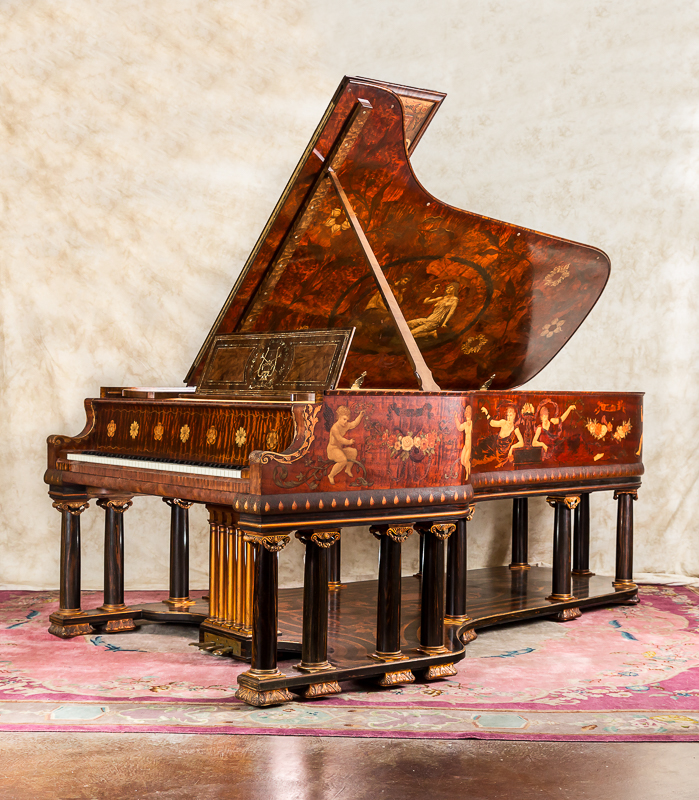
1893 Steinway Model D by Cottier & Co.
This unique instrument was built for Mrs. Thomas Alexander Scott of Philadelphia PA, the widow of Thomas A. Scott, president of the Pennsylvania Railroad. It was shipped in November of 1894 from the Steinway factory to the Stetson Agency, Steinway's representative in Philadelphia. From there it traveled to Cottier & Co. in New York City, renowned artisans of the era where a complete new case was designed featuring an inlaid floor and highly decorated case with exotic woods, painting and mother of pearl inlay. A fully modern instrument, the piano survives today in excellent urestored condition, retaining its original soundboard and genuine ivory keys. Size 9ft. Serial number 76000.
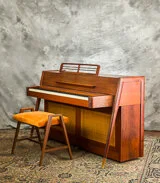
The “Acrosonic” model was introduced by Baldwin in 1936 when the trend towards smaller homes led to the development of the spinet, the smallest of the acoustic piano designs. Because the diminutive size of spinets greatly compromised their tonal capabilities, Baldwin designed the Acrosonic with a high tension stringing scale and top quality woods to produce a piano with a fine tone given its small size. Over the years pianists and teachers came to recognize the Acrosonic as the “best of the spinets”. Many thousands were sold between the 1930s and the 1990s when spinet production ceased throughout the industry. Acrosonics were offered in hundreds of cabinet designs but one of the rarest is the striking Danish Modern style offered here. The walnut cabinet features dramatic diagonal legs, mirrored in the matching bench. The back side of the piano is fully finished with walnut and caned panels, making this one of the rare vertical pianos that can be displayed in the middle of a room. Size 36in. Serial number 798858.
This striking instrument is one of the very few limited edition art cases executed on the venerable Hamburg Steinway platform. Constructed in 2004-5 celebrating 125 years of the Hamburg factory and built in an edition of just 125 (this being number 13), these rare “Goertz Steinways” rarely come on the market. “Equating music with movement, Count Albrecht von Goertz, the creator of arguably the world’s most beautiful sports car, the BMW 507, designed the 125th anniversary limited edition piano which is notable for its simplicity that would reflect this idea. He decided to accentuate the finish, creating a dynamic interplay between contrasting satin and highly polished surfaces. The result is an elegant and timeless design with a hint of sensuality.” Size 6ft 2in. Serial number #572828.
SOLD